LANG DULAY:
Weaving Dreams, Preserving Culture
“Behind these fabrics are patterns that hold a story, thread that speak of dreams”
Step into the world of Lang Sapiaen Dulay, where timeless artistry and cultural heritage prevails. Lang Dulay, the legendary T’nalak weaver, crafts not only mere fabrics but weaves thread that carries stories. Stories that symbolize the essence of their culture and identity.
Enchant yourself with the intricate patterns of each weave and delve into what they whisper to you.
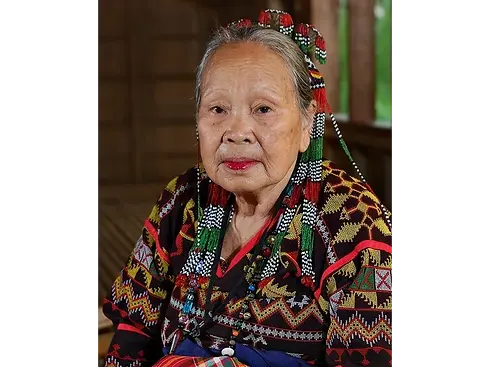


Who is Lang Dulay?
T’nalak Master Weaver & GAMABA Artist
Lang Sapiaen Dulay is a traditional Filipino weaver and a T’boli princess, known as the “T’nalak Master Weaver.” She was from Lake Sebu, South Cotabato and was born on August 3, 1928. She started weaving at the age of 12, learning the sacred craft from her mother, Luan Senig. She passed away in 2015 at the age of 86.
More About Lang Dulay
-
She crafted about a hundred designs of patterns, each with different stories. Each of these were based on her dreams, making her the “dreamweaver”.
-
In 1998, Lang Dulay received the National Living Treasure (Manlilikha ng Bayan) award from the National Commission for the Culture and the Arts (NCCA) for her contribution in Philippine culture and art. She was honored for both her commitment to maintaining their culture and identity and her extraordinary skill in weaving T'nalak clothing. Her intricately woven T'nalak textiles serve as a representation of the T'boli people's excellent weaving traditions and their rich heritage.
-
Embedded in her legacy is Manlilikha ng Bayan Center, the weaving center she established to teach young generations of T’boli weavers. Aside from weaving on her own, she envisioned keeping the T’boli tradition alive and empowering their identity. She believed that maintaining traditional ways of life was essential, even in the face of globalization and modernization.
Weaving Process
01
Abaca plant stems are stripped to get the fibers and the good and finest fibers are selected.
02
Selected fibers are connected together and dyed in red, black, and white, which are the colors representing the T’boli tribe. They dye it by boiling the abaca strands with the roots of a loco tree to get a red color, leaves and fruits of a kanalum tree for black.
03
After cooking for about 1 month, the fibers are then tied by a hand on a bamboo “bed-tying” frame.
04
The tied fibers are interlaced vertically and horizontally to create the intricate T’nalak cloth.
Lang Dulay's Art Gallery:
T'nalak Textiles

Dudum Lobun bordered with Betek Kefung
-
Represents vastness of life
-
Continuity and expansive nature of life
-
The border pattern protects, balances, and gives structure to central motif
-
harmony between inner world and outer boundaries

Dudum Lobun bordered with Basag
-
Nature of existence
-
“Basag” means fragmentation or breaking
-
Represents life’s challenges, changes and imperfections
-
Duality between order and chaos
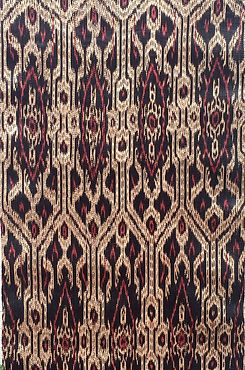
Banggala
-
Characterized with flowing and dynamic lines
-
Represent moving water and gentle waves
-
Suggests fluidity, motion, and transformation
-
May symbolize the continues flow of life, passage of time, or natural cycle

Mebaga Klagan
-
Spreading or expansion
-
Shows growth and expansion
-
Shows richness in a thriving state
-
Echoes radiating energy and symbolizes growth and blessings
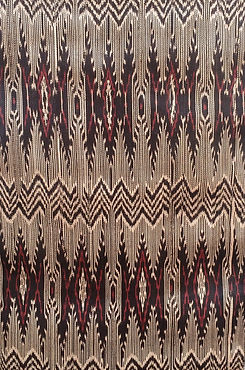
Gemayaw
-
soaring or flying
-
symbolizes the image of birds flying or any upward movement
-
Represent freedom and aspiration
-
The pattern strokes embody the earthly limitations

Lel Alah
-
Lel means path or way and
-
Alah means concept of God
-
Symbolizes the journey of life with the guidance of the higher ups
-
Represent destiny, guidance and spiritual path
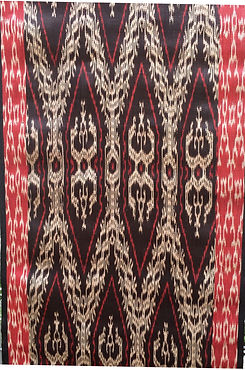
Gemewet
-
intertwined or woven together
-
overlapping and interlocking motifs
-
represents unity and interconnectedness
-
the pattern may show deep bonds and collective strength when worked together
References
Members (MEB11)
-
National Commission for Culture and the Arts. (2019, September 3). GAMABA: LangDulay.https://ncca.gov.ph/about-culture-and-arts/culture-profile/gamaba/national-living-treasures-lang-dulay
-
TBoli Arts: An appreciation. (n.d.). WebsiteBuilder.https://www.tboliarts.com/tnalak---lang-dulay.html
-
Lang Dulay: The national living treasure. (2013, August 10). SunStar Publishing Inc. https://www.sunstar.com.ph/more-articles/lang-dulay-the-national-living-treasure
-
LIVING ASIA CHANNEL. (2014, May 16). WINDOW Lang dulay [Video]. YouTube.https://www.youtube.com/watch?v=EvNFvTHFHAs
-
Wikipedia contributors. (2024, July 20). Lang dulay. Wikipedia. https://en.m.wikipedia.org/wiki/Lang_Dulay
-
Agapito, Patricia
-
Baria, Chelsea Sofiel
-
Dycoco, Nikki Pauleen
-
Rivera, Leigh Anjela
-
Mujar, Rionoa Savria